
Presented at the Dam Safety Conference - CDSA/CANCOLD Joint, in Montréal Canada, September 1997.
WATER ALARM CONCEPT ACCORDING TO THE SWISS REGULATION
CONCEPT DE L’ALARME EAU SELON LES REGLEMENTS SUISSES
Author Jean-Marc Regamey, Stucky Consulting Engineers
Abstract
The Swiss regulation for dams is based on a law dating from 22 June 1877, 120 years ago.
An executive decree, dating from 1957, gives more precision. A major modification of this decree has been introduced more recently and is valid from 1 January 1986. It extends the safety concept with the introduction of emergency concept beside structural safety and monitoring.
The purpose of this paper is to present the main element of this emergency concept, the water alarm. An example of application to a real case will also be given.
Résumé
La loi fédérale (suisse) sur la police des eaux date du 22 juin 1877, il y a plus de 120 ans.
Un règlement d'application, datant de 1957, en précise un certain nombre de points. Une récente mise à jour, en vigueur depuis le 1er janvier 1986, étend le concept de sécurité des barrages en introduisant la notion d'urgence aux côtés de la sécurité structurale et de l’auscultation (monitoring).
L'intention de cette contribution est de présenter le principal élément de ce nouveau concept de sécurité, l'alarme eau. L'application à un cas concret est présentée.
Legal aspects
The Swiss regulation [1] contains several items relating to the Swiss conditions (political, military, . ), not relevant to this presentation. I will therefore mention only the information regarding the water alarm. It is mainly included in Art. 20, 23 & 29 of the executive decree of 1957, updated in 1986.
Article 20
The different elements of a plant have to be designed and built in such a way as to satisfy the normal operational requirements. Furthermore, they have to provide maximum safety to the downstream area also in case of destruction due to acts of war or the like.
In the case of dams, it has to be examined individually whether this safety can be achieved by constructive provisions, by a rapid drawdown of the reservoir, or a combination of both methods.
Art. 23 ter
1 The following Degrees of Preparedness (DP) are valid for the water alarm system:
- a) DP 1: link between water alarm center and water alarm sirens disconnected; water alarm sirens locked, no warning staff on duty;
- b) DP 2: link between water alarm center and water alarm sirens in working condition, water alarm sirens locked, no warning staff on duty;
- c) DP 3: water alarm system in working condition, no warning staff on duty;
- d) DP 4: water alarm system in working condition, warning staff on duty.
2 Ordinarily, DP 2 is valid in peacetime, DP 4 in all other strategic cases.
Art 29
1 In case of extraordinary events such as unusual behavior of the dam, earthquakes, landslides, rockfalls, avalanches, etc. which could affect the safety of the dam or induce an extraordinary flood, the plant management has to take all appropriate actions immediately to avert an impending threat to the dam. Possibly, the precautionary drawdown of the reservoir has to be started, if feasible within the capacity of the downstream river-bed. The management appoints qualified professional engineers as consultants. The Supervising Authorities of the State and the Confederation have to be informed as quickly as possible.
2 Circumstances permitting, these precautions are taken in agreement with the Supervising Authority. If necessary, the Supervising Authority may request the State and the plant management to act accordingly.
Art 29 quater
The water alarm has to be released, if
- in case of an exceptional event, a flood wave can probably not be avoided any longer;
- in case a destruction was produced by acts of war leading to an important water release.
The release in due time of the water alarm is the responsibility
- in case of an exceptional event, of the dam Owner
- in case of acts of war, of the Military Authorities.
Elaboration of water alarm strategy.
The dam owner has to prepare a document presenting the strategy to be followed in case of an "extraordinary" event. As there is a legal basis behind this strategy, the Supervising Authority will have to give its approval. A general concept has been established by the Authority [2] in order to facilitate the task of the Owners (or their Engineers).
The case of a flood is particularly important as, especially in the Alps, the phenomenon generally develops in a very short period. It is, therefore, not possible to call for experts and, generally, local action has to be taken rapidly. The dam attendants have to be in possession of all elements allowing them to make the relevant decision.
Basic data for the water alarm strategy.
Prior to elaborating the water alarm strategy it is necessary to collect (if available) or to perform the following studies :
1 Hydrology : the inflow hydrogram has to be well established. In Switzerland we are using the notion of the Q1000 flood and of the "Déluge", assumed to be 1.5* Q1000. In the case of a recent flood, it will probably be necessary to update previous studies (generally leading to a higher design flood . . .)
2 Hydraulics : the characteristics of the dam have to be well known ; spillways, gates, eventual overtopping in the case of concrete dams.
3 Topography : the characteristics of the dam area have to be well known ; access road(s), river crossings, walking distance from living area for dam attendants.
Parameters to be used.
In the case of a flood, the follow up of the situation, as well as the necessary decisions, will be taken according to the following parameters :
Hcrit Critical level : lake level before the flood allowing the danger level to be reached in case of the max. flood.
Hs Lake level at which surveillance staff have to be sent to the dam
Hz Lake level at which dam access will no longer be possible
HDP3,4 Lake level at which it will be necessary to declare degree of preparedness 3 and 4, respectively.
HA Lake level at which the alarm shall be declared
HG Lake level at which dam failure will probably occur
TM Access time to the dam, including preparation
VM Lake water rise velocity [cm/h, m/h]
For each dam, these parameters will have to be adapted to the local conditions. A practical example will be given below, with explanations regarding the choice of the parameters.
Example of the water alarm strategy for a Swiss dam [3].
1 Dam characteristics
Catchment area 41 km2
Dam type Concrete arch
Dam height 86 m
Crest length 460 m
Crest elevation 1811.00 m.
Normal operating level 1810.00 (1m freeboard)
Lake area 600'000 m2
Storage capacity 20'000'000 m3
Free spillway 43 m - 87 m3/s max.
Bottom outlet 2.0 x 1.35 m2 - 98 m3/s max.
2 Inflow and outflow hydrograms
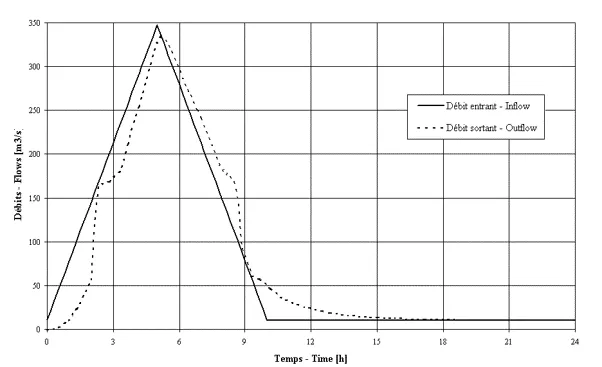
Fig 1. - Hydrogram of the Déluge flood
© Gruner Stucky Ltd
Fig 1. - Hydrogram of the "Déluge" flood
For such a small catchment area, and without relevant information regarding measured flows, a simplified hydrogram has been used, based on rain intensity curves established for the area. The triangular shape has been chosen. The lake characteristics show that the retention effect is limited (outflow nearly equal to inflow). The diagram used for the water alarm calculation is given in Fig. 1.
3 Choice of the parameters
HG Danger level : for this concrete dam, an overtopping of 0.2 m is accepted, placing HG to 1811.20
Hcrit Critical level : it has been calculated as 1804.00, 6 m. below the actual max. level.
HZ Access to the dam is always possible, being along a main, well protected road. HZ has been determined to allow the dam attendants to be present at Site 1 hour before DP3
TM Access time to the dam, including preparation, has been estimated at 2 hours
HS Surveillance staff has to be sent to the dam 2 hours before HZ
HA The alarm shall be declared 1 hour before HG is reached
HDP4 The degree of preparedness 4 will be declared 1 hour before HA
HDP3 The sirens having to be ready 1 hour before HG is reached, and the dam owner assuming that 1.5 hours are necessary to put them under operation, the degree of preparedness 3 will be declared 1.5 hour before HA
4 Opening of the bottom outlet.
Various calculations have been made to establish the instructions for the opening of this valve. It has been finally decided to operate this valve before declaring the alarm. The personnel having to be present at Site early enough, this opening will not be a restrictive criteria. Take shall also be taken for the downstream conditions. The sudden release of nearly 100 m3/s must be carried out only if there is no other choice.
5 Elaboration of the water alarm diagram
All these parameters will allow us to finally prepare the water alarm diagram. It will be the result of an iterative process, each scheme being different due to its water release capacities.
As can be seen in Fig. 2, the diagram represents the lake level as a function of the water level rise velocity, which is an uncommon unit ! It shows clearly that, if the water rise is small (< 10 cm/s) the situation does not require special action. In the case where the water rise reaches higher values (> 50 cm/s), all actions shall be taken for a lower lake level.
Another representation is given in Fig. 3, showing evolution of the water level as a function of time. The delays from one action to the next can be seen. It has be noted that they are very short. This is mainly due to the shape of the hydrogram. In fact, it can be assumed that an "extreme" flood will be included in another event and will then not rise so rapidly. The case shown can be considered as an "extreme" case.
6 Use of the diagram
Such a diagram shall be permanently at the disposal of dam attendants.
As soon as the critical level Hcrit is reached, in case of water level rise, the follow up of the event has to be made according to the instructions (measurement every day-hour-... depending on the dam characteristics).
Later on, as soon as a limit is reached, the corresponding action shall be taken: personnel sent to Site, DP3, DP4, Alarm.
In most cases the water rise will stop, allowing the dam attendants to return to " normal" activities.
Fig 2. - Water alarm diagram
Fig 3. - Evolution of the water level
Conclusion
This example, selected deliberately, shows that this specific dam presents a lack of water release capacities. The result of this study has led the Owner to modify the spillway. For other dams, the alarm level is supposedly never reached. But in any case, this process is evolutionary. A recent event could affect all the hydrology calculations, modifying flood hydrograms. A new water alarm strategy would then be elaborated.
Q1000 and Déluges are not frequent ! In these conditions the application of all the steps of the strategy is improbable. The Owner shall keep his dam attendants well motivated. An "exercise" to test the intervention times would be greatly recommended.
The strategy shown here above is only a part of the general concept. Effectively, a wide organization shall exist " downstream" . Not only the dam Owner, but the Local, Regional and Federal Authorities are deeply involved in this strategy. The information has to be transferred from the dam to the population living in the area endangered to be flooded.
Such a strategy has to be adapted to the existing political, military, civil safety organizations. Its transposition to another country should be thought deeply, and would most probably need adaptations.
Acknowledgments
This concept of water alarm has been elaborated by the Federal Office for Water Management, under the direction of Dr. R. Biedermann, former Commissioner for Dam Safety.
Bibliography
[1] Police des eaux
Loi fédérale sur la police des eaux du 22 juin 1877
Règlement d'exécution du 8 mars 1879 concernant les eaux dans les régions élevées
Règlement d'exécution du 9 juillet 1957 concernant les barrages
Etat le 1er juillet 1994
This document does exist in French, in German or in Italian languages
[2] Stratégie d'urgence en cas de crues - Office fédéral de l'économie des eaux - 1987
Emergency strategy in case of floods - Federal Office for Water Management
[3] Internal reports - Stucky Consulting Engineers
Also of interest (in English et en français)
[4] Safety concept for dams : Developments of the Swiss concept since 1980 -
Dr. R. Biedermann - "wasser, energie, luft - eau, énergie, air" Heft 3/4, 1997
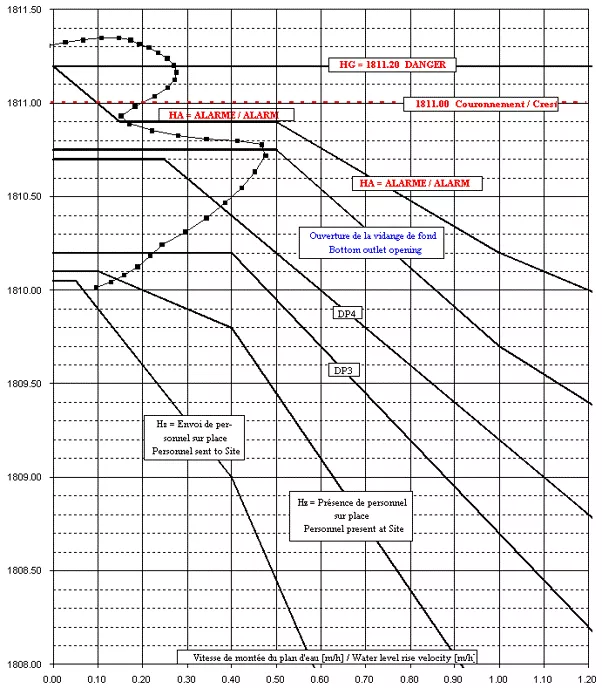
Fig. 2 -Water Alarm Diagram
© Gruner Stucky Ltd
Fig 2. - Water alarm diagram
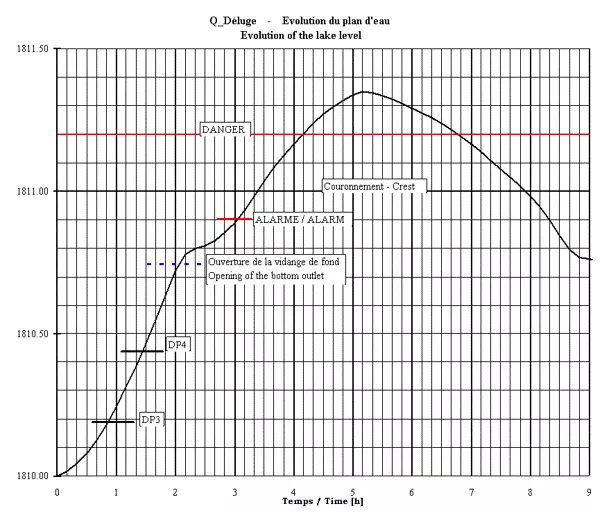
Fig. 3 - Evolution of Water Level
© Gruner Stucky Ltd
Fig 3. - Evolution of the water level
Conclusion
This example, selected deliberately, shows that this specific dam presents a lack of water release capacities. The result of this study has led the Owner to modify the spillway. For other dams, the alarm level is supposedly never reached. But in any case, this process is evolutionary. A recent event could affect all the hydrology calculations, modifying flood hydrograms. A new water alarm strategy would then be elaborated.
Q1000 and Déluges are not frequent ! In these conditions the application of all the steps of the strategy is improbable. The Owner shall keep his dam attendants well motivated. An "exercise" to test the intervention times would be greatly recommended.
The strategy shown here above is only a part of the general concept. Effectively, a wide organization shall exist " downstream" . Not only the dam Owner, but the Local, Regional and Federal Authorities are deeply involved in this strategy. The information has to be transferred from the dam to the population living in the area endangered to be flooded.
Such a strategy has to be adapted to the existing political, military, civil safety organizations. Its transposition to another country should be thought deeply, and would most probably need adaptations.
Acknowledgments
This concept of water alarm has been elaborated by the Federal Office for Water Management, under the direction of Dr. R. Biedermann, former Commissioner for Dam Safety.
Bibliography
[1] Police des eaux
Loi fédérale sur la police des eaux du 22 juin 1877
Règlement d'exécution du 8 mars 1879 concernant les eaux dans les régions élevées
Règlement d'exécution du 9 juillet 1957 concernant les barrages
Etat le 1er juillet 1994
This document does exist in French, in German or in Italian languages
[2] Stratégie d'urgence en cas de crues - Office fédéral de l'économie des eaux - 1987
Emergency strategy in case of floods - Federal Office for Water Management
[3] Internal reports - Stucky Consulting Engineers
Also of interest (in English et en français)
[4] Safety concept for dams : Developments of the Swiss concept since 1980 -
Dr. R. Biedermann - "wasser, energie, luft - eau, énergie, air" Heft 3/4, 1997