March 23, 2022
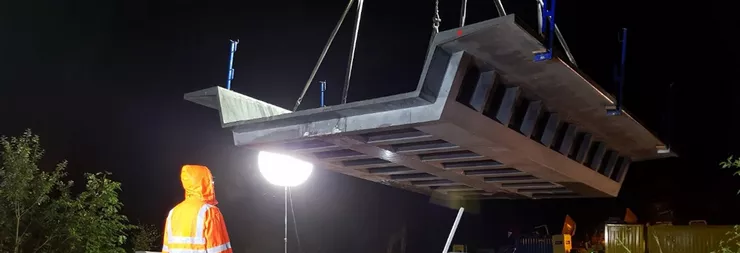
The Aiguillon railway bridge in Switzerland, one of the first railway bridges completely made of Ultra-High-Performance Fiber-Reinforced Cementitious Composite (UHPFRC)
The Aiguillon railway bridge was completed in July 2021 using reinforced Ultra-High-Performance Fiber-Reinforced Cementitious Composite (UHPFRC). This successful construction confirms the potential and perspective of the appication of UHPFRC material for the construction of new structural elements for infrastructure projects.
The Aiguillon railway bridge was completed in July 2021 using reinforced Ultra-High-Performance Fiber-Reinforced Cementitious Composite (UHPFRC). This successful construction confirms the potential and perspective of the appication of UHPFRC material for the construction of new structural elements for infrastructure projects. The project reference can be viewed here.
A paper on the project has just been published for the IABSE symposium in Prague 2022 The paper is entitled "Short span UHPFRC railway bridge in Switzerland - from design to implementation" and the abstract is written below:
The paper was written by:
Ngoc Thanh Trinh
Project Manager, Deputy head of Leman Engineering Structure Department, Gruner Stucky Ltd, Switzerland
Numa Joy Bertola
Postdoctoral Researcher, Structural Maintenance and Safety Laboratory, EPFL, Switzerland
Enrique Garcia
Project Manager, TRAVYS Ltd, Switzerland
Eugen Brühwiler
Professor, Head of Structural Maintenance and Safety Laboratory, EPFL, Switzerland
Abstract
This paper presents the design and construction of the Aiguillon railway bridge in Switzerland, one of the first railway bridges completely made of Ultra-High-Performance Fiber-Reinforced Cementitious Composite (UHPFRC). The length and width of the trough girder are respectively 6.6 m and 5.7 m. It is designed for a narrow-gauge track and two walkways. The trough is composed of two prefabricated elements in UHPFRC with steel reinforcement bars. These elements are first built in the plant and then are assembled on site by a longitudinal cast-in-place joint.
The challenges and the experiences in this project are discussed and analysed in view of future projects. Furthermore, the full-scale suitability tests to validate the joint between the two prefabricated elements are described. The test results of the structural resistance of the joints are in good agreement with analytical results.
The laboratory experimentation required to validate the keying joint suitability for railway bridges was also the subject of a techincal paper published in the International Journal on Materials and Structures it is accesiible at the following link:
https://link.springer.com/article/10.1617/s11527-022-01931-x