
August 19, 2026
Fire Safety Revision: Greater Flexibility, Greater Responsibility
From autumn 2027, fire safety regulations are set to be applied in a more risk-based and consistent manner across Switzerland. This will give construction projects greater scope for proportionate solutions – but will also place higher demands on risk assessment and documentation. Experts discussed what this means in practice at this year’s Gruner Fire Safety Forum.
Fewer checklists, greater risk expertise: the planned revision of the fire safety regulations shifts the focus from formal requirements to well-founded solutions. As a result, fire safety is expected to be integrated into the planning process earlier and more systematically.
Experts discussed how this approach will affect planning, development and approval processes at Gruner’s Fire Safety Forum on 4. June in Zurich. “Greater flexibility does not mean less fire safety – quite the opposite: anyone taking a risk-based approach to planning must be able to justify their decisions even more thoroughly,” says Bojan Stevanovic, Head of Fire Safety at Gruner in Zurich, who moderated the event and opened the discussion by providing a professional perspective on the revision.
The subsequent panel discussion, featuring perspectives from development, planning and the approval process, demonstrated just how far-reaching the new requirements will be for the construction industry. Stefan Gabriel, CEO of Fortimo AG, presented the real estate development perspective; Sebastian El Khouli, Partner at BGP Architekten and Head of Sustainability and Building in Existing Structures, examined the implications for planning; and Ivan Bettera, specialist responsible for building and fire safety authorities at Gossweiler, assessed the requirements from the perspective of approval practice.
More Consistent Fire Safety Regulations Across Switzerland
One of the revision’s key objectives is to ensure more consistent application of fire safety regulations throughout Switzerland. Particularly for complex projects or those spanning multiple cantons, this would mean greater transparency, more efficient processes and increased planning certainty. “Consistent requirements across cantonal borders would simplify projects and make them easier to compare,” says Stefan Gabriel, CEO of Fortimo AG. The St. Gallen-based real estate company supports residential and tourism projects throughout their entire life cycle.
Risk-Based Fire Safety and the ALARP Principle
At the same time, risk-based fire safety is becoming increasingly important. In future, greater emphasis is likely to be placed on determining the specific risk associated with a project – and identifying which measures can reduce that risk effectively and proportionately. This also brings the ALARP principle increasingly into focus, according to which risks should be reduced as far as is reasonable, practicable and proportionate. “The aim will not be to implement every theoretically possible protective measure,” says Bojan Stevanovic. “What matters is whether a measure reduces the specific risk effectively and proportionately.”
“Greater Flexibility Does Not Mean Less Safety”
Greater flexibility does not mean that fundamental safety requirements will be relaxed. Ivan Bettera, specialist responsible for building and fire safety authorities at Gossweiler, emphasised this point: “Certain requirements, for example regarding escape routes or occupancy levels, remain indispensable. The challenge is to assess risks transparently while at the same time ensuring a high level of safety.”
Fewer Checklists, More an Integral Part of Good Planning
From a planning perspective, the revision shifts the focus towards the early stages of the planning process. For Sebastian El Khouli, Partner at BGP Architekten and Head of Sustainability and Building in Existing Structures, this also means adopting an integrated understanding of fire safety: “In future, there will be a greater focus on identifying the actual risk and determining how it can be reduced appropriately.” Fire safety will therefore become less of a checklist at the end of the process – and more of an integral part of good, early-stage planning.
The Revision Means Fire Safety Must Be Integrated Earlier into Planning
The expert panel concluded that the risk-based approach will increase the demands placed on everyone involved. Planners, fire safety experts and clients will need to assess risks professionally and provide transparent justification for their decisions. For Bojan Stevanovic, this is one of the most important changes: “If risks are assessed more specifically for each individual project in future, we will need specialists who are prepared to take responsibility and develop robust solutions. This can only work with sound expertise.”

Panel guests Ivan Beterra (Gossweiler), Sebastian El Khouli (BGP Architekten), Stefan Gabriel (Fortimo AG) and host Bojan Stefanic (Gruner) following the event in Zurich.
© Gruner
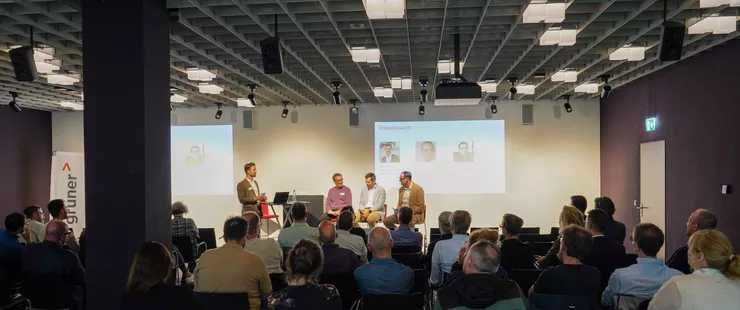
As part of the panel discussion, Bojan Stefanic, Stefan Gabriel, Sebastian El Khouli and Ivan Beterra discussed the impact of the new fire safety regulations on planning, permitting and project delivery.
© Gruner

During the networking apéro following the presentation, participants took the opportunity to exchange ideas and connect on current topics related to fire safety and building construction.
© Gruner